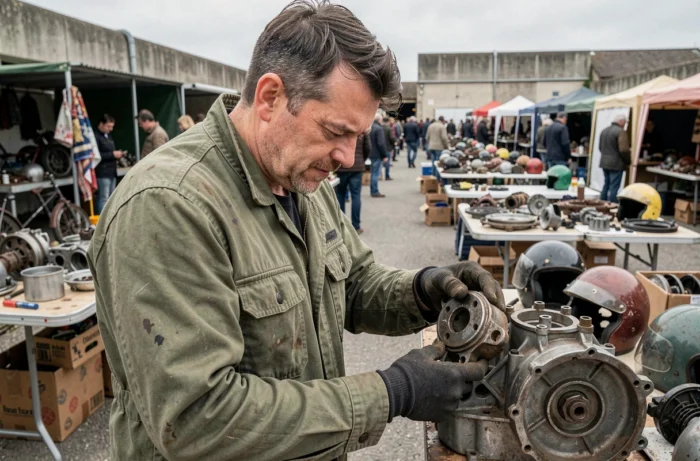
In the French market, used motorcycle parts suffer from a lack of structuring that the automotive sector has largely resolved. The supply remains scattered, traceability varies from seller to seller, and sourcing times can be surprising. Finding the right part at the right price requires a precise method, not just patience.
Manufacturer Reference and Compatibility: The Technical Filter Before Any Search
Searching for a part by generic name (“Suzuki 600 fairing”) generates noise. We recommend always starting from the OEM reference engraved on the original part or listed in the manufacturer’s catalog (microfiche). This ten or twelve-character reference eliminates compatibility errors between model years, especially on Japanese models where annual changes silently modify fastenings or connectors.
A Brembo brake caliper mounted on a 2018 Ducati Monster 821 does not necessarily have the same spacing as that of a 2015 821. Without the OEM reference, the private seller cannot confirm compatibility, and the return will be at your expense.
To find these references, online databases like CMSNL or Partzilla cover nearly all manufacturers. Some French motorcycle wreckers also index their stock by OEM reference, which speeds up the search. You will also find useful information on Nox Autos regarding the operation of these recovery channels and their pricing policies.
Used Motorcycle Parts from a Professional: Legal Warranty Changes the Game

Since October 1, 2024, two-wheeled vehicle repairers must offer parts from the circular economy when possible. This obligation covers removable bodywork, upholstery, non-bonded glass, optics, and certain mechanical or electronic parts. However, structural elements and safety parts remain excluded: wheel axles, brake linings, frame, chassis.
Buying from a professional provides a protection that transactions between individuals do not guarantee. The legal warranty of conformity applies to used parts sold by a pro. For used goods, the defect is presumed to have existed prior to the sale for twelve months (articles L217-3 to L217-32 of the Consumer Code).
In practical terms, if a used engine purchased from a professional wrecking yard has an internal defect within twelve months, it is up to the seller to prove that the defect did not exist at the time of sale. In a private ad, this presumption does not work the same way.
What This Obligation Changes for Pricing
Workshops that now offer reused parts as a first option create a volume effect on demand. Bodywork and optics parts are the most affected, as they represent the majority of motorcycle accidents and are easily removable without alteration.
A used side fairing or rear light costs significantly less than its new equivalent, sometimes by half or more depending on the model. For mid-range motorcycles, the price difference alone justifies going through the used channel for anything related to bodywork.
Sales Channels in France: Where to Search According to the Type of Part
Not all channels are equal depending on the nature of the part sought. We distinguish three main circuits, each with its strengths and limitations.
- Professional motorcycle wreckers: indexed stock, legal warranty, tested or visually inspected parts. The most reliable channel for engine parts, electrical harnesses, and cycle parts. Prices remain higher than private ads, but the legal security compensates.
- Classified ad platforms (Le Bon Coin, specialized forums like those of Passion Moto or brand clubs): often the lowest prices, but no formal guarantee. Suitable for body parts, accessories, or non-critical elements whose condition can be visually verified.
- Sales groups on social networks, especially Facebook groups dedicated to a brand or model: the community partially regulates trust through reviews and seller history. The risk remains that of any transaction between individuals.
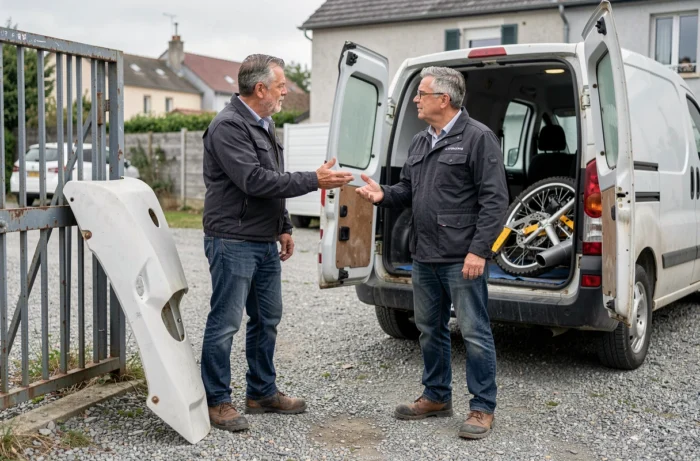
Critical Mechanical Parts: A Professional Channel or Nothing
For a crankshaft, gearbox, or injection harness, transactions between individuals present a disproportionate risk. The internal condition of these components cannot be verified through photos. A used engine well inspected by a professional is as protected as a new one for a fraction of the price, provided you go through a seller subject to the legal warranty.
Negotiation and Price Monitoring for Used Motorcycle Parts
The used motorcycle parts market in France does not have a centralized aggregator comparable to what exists in the automotive sector. The direct consequence: price discrepancies for the same reference can vary greatly from one seller to another.
The most effective method is to cross-reference results from at least three sources (a professional wrecking yard, an ad platform, a community group) before buying. On brand forums, regular members know the usual prices and report abusive pricing.
- Set up alerts on Le Bon Coin with the exact OEM reference, not the generic name of the part. You will receive relevant ads without noise.
- Monitor sales of crashed or decommissioned motorcycles (TNR vehicles, “everything non-running”). A motorcycle declared irreparable by insurance can provide dozens of parts in good condition at a bargain price.
- Always negotiate on ads older than two weeks. A private seller who has not sold quickly often accepts a significant discount.
Parts for common Japanese models are easier to find than those intended for niche European models. For a Suzuki SV 650 or a Honda CBR 600, the available stock in used parts remains abundant all year round. For a Moto Guzzi V85 TT, patience becomes a key factor.
The French market for reused motorcycle parts is gradually structuring itself, driven by regulatory obligations and the rise of specialized wrecking yards. Buying used is no longer a default choice: it is a technical approach that, when well executed, combines real savings and legal protection comparable to new.