
The windshield washer fluid and coolant serve radically different functions under the hood, but their containers are increasingly similar. On recent vehicles, the filling openings are close together, sometimes hidden by plastic covers. According to the Aftermarket Car report by Traxio published in March 2024, incidents related to pouring a fluid in the wrong place have increased, particularly on Euro 6d and hybrid vehicles less than five years old.
Knowing how to distinguish these two fluids before pouring them can prevent an expensive breakdown.
Windshield Washer Fluid and Coolant: Comparison Table of Characteristics
| Criteria | Windshield Washer Fluid | Coolant |
|---|---|---|
| Function | Clean the windshield and windows | Regulate engine temperature |
| Common Color | Bright blue, sometimes pale blue or colorless | Pink, orange, green, or yellow depending on the standard |
| Texture | Fluid, similar to water | Slightly viscous, greasy to the touch |
| Odor | Alcoholic or soapy | Sweet, sometimes acrid |
| Reservoir Cap | Windscreen wiper / water jet pictogram | Thermometer or wave pictogram, often yellow or black |
| Risk in Case of Error | Streaks on the windshield if improperly dosed | Engine overheating, damaged head gasket |
This table is sufficient in most cases. To know how to recognize windshield washer fluid and coolant at first glance, the combination of color, texture, and cap remains the most reliable trio.
Color and Texture of Liquids: Why Visual Identification is Complicated
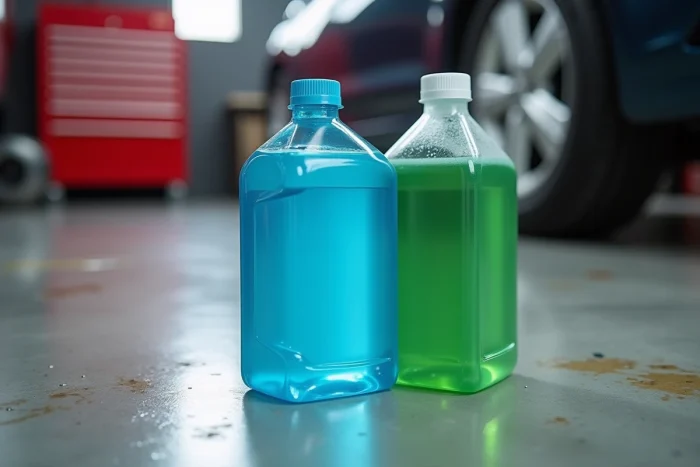
The bright blue of traditional windshield washer fluid made it easy to spot. In recent years, formulations have evolved. Auto Plus reported in December 2024 that several brands market almost colorless or pale blue all-season washer fluids, incorporating hydrophobic additives. These shades are similar to some long-life OAT coolants, which are often pink or light orange themselves.
However, the texture does not lie. Coolant contains ethylene glycol or propylene glycol. Rub a drop between your thumb and index finger: coolant leaves a greasy and slippery film. Washer fluid, made from water and alcohol, evaporates quickly and leaves no oily residue.
The odor serves as a second filter. Washer fluid emits a pronounced alcoholic note, sometimes mixed with detergent. Coolant has a sweetish, almost sugary smell related to glycol. If you still have doubts, do not pour anything and consult the vehicle’s maintenance manual.
Identifying the Correct Reservoir Under the Hood of a Recent Vehicle
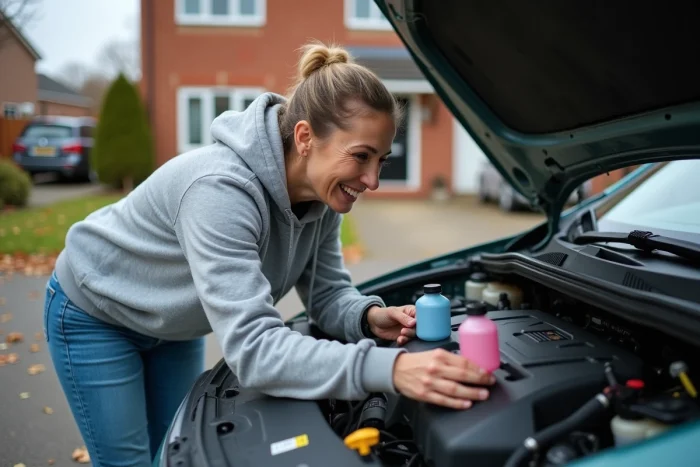
The color of the fluid helps, but identifying the correct reservoir remains the first barrier. On recent models, engine compartments are covered with plastic covers that hide the caps. The Traxio report from March 2024 emphasizes that errors mainly concern vehicles less than five years old, precisely because the openings are less visible than before.
Pictograms and Cap Colors
The windshield washer reservoir features a pictogram depicting a windshield crossed by a water jet. Its cap is usually blue or black. The coolant reservoir displays a thermometer or a steam symbol, with a cap often yellow.
On some hybrid or transverse engine vehicles, the two reservoirs are side by side, just a few centimeters apart. Taking five seconds to read the pictogram is enough to avoid a mix with very different consequences.
What the Manufacturer’s Manual Says
Each manufacturer recommends a specific type of coolant, identified by a standard (G11, G12, G13 at Volkswagen, for example). Mixing two incompatible standards causes gelling that clogs the circuit’s pipes. Washer fluid, on the other hand, tolerates more mixing between brands, although an overly aggressive concentrate can damage the nozzle seals or the polycarbonate of some headlights.
Consequences of a Filling Error: Washer Fluid in the Cooling Circuit
Pouring washer fluid into the cooling circuit is the most common and risky mistake. Washer fluid, primarily composed of water and methanol, provides no protection against overheating beyond its boiling point, which is much lower than that of coolant. The engine can overheat within minutes of driving.
Methanol also attacks rubber seals and hoses in the cooling circuit. On a Caradisiac forum, several testimonies describe leaks appearing a few days after an incorrect filling, even if partial.
- If you poured a small amount of washer fluid (less than a glass) into the cooling circuit, a complete drain followed by a rinse with demineralized water may suffice.
- If the engine has run with this mixture, have the hoses, thermostat, and head gasket checked by a professional.
- Conversely, coolant poured into the washer fluid reservoir leaves a greasy film on the windshield, reduces visibility, and may clog the nozzles. Draining the reservoir and rinsing resolves the issue.
Three Reflexes Before Every Automotive Fluid Filling
Rather than a long checklist, three gestures reduce the risk of error to almost zero.
- Read the pictogram on the reservoir cap, even if you think you recognize it. Visual memory can be misleading, especially on a vehicle you have only owned for a short time.
- Touch a drop of the liquid you are about to pour. A greasy film indicates coolant, while a watery liquid that evaporates quickly is washer fluid.
- Check the standard indicated on the coolant can and compare it to that in the maintenance manual. A can without a standard indication has no place in a cooling circuit.
Filling errors are not reserved for beginners. They increase with the complexity of today’s engine compartments. Identifying the correct reservoir and fluid takes a few seconds, while repairing an overheated engine takes much longer.