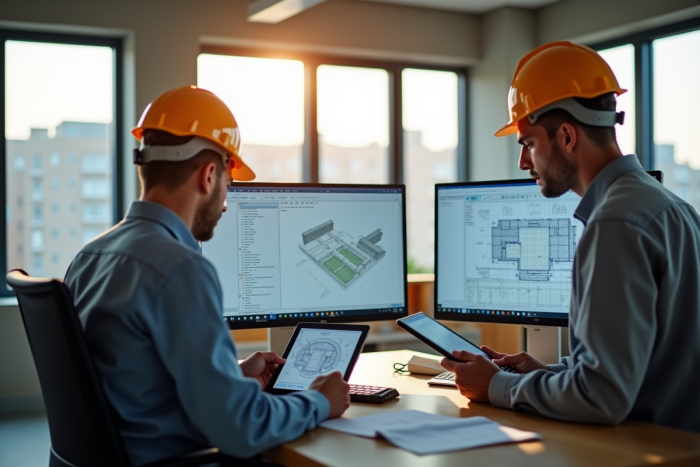
Construction companies are still losing up to 25% of their revenue due to administrative errors or lack of follow-up. However, some are managing to drastically reduce these losses without increasing their workforce or budgets.
This evolution is based on the growing adoption of digital solutions dedicated to site management, planning, or financial tracking. The market is evolving rapidly with increasingly specialized tools, tailored to the size and specific needs of each organization.
Overview of management software in construction: which tools for which needs?
Today, business management in construction is no longer limited to juggling a few invoices or issuing quotes. Over the years, construction software has become the nerve center of the activity: it coordinates team planning, supplier management, customer relations, and information flow. Each construction company has a real digital toolbox to track projects from initial contact to final delivery.
Given the diversity of trades and needs, each software finds its place.
- ERPs handle all administrative and financial tasks: expense tracking, HR management, purchase automation, inventory control.
- Site management solutions integrate planning, document management (DMS), communication with subcontractors, and quality control.
Work habits are also evolving on the ground. Thanks to mobile applications, site managers have responsive tools to access their dashboards, report progress, share photos or documents, directly from their phones. As a result, the management of unforeseen events becomes faster, and the traceability of actions improves. On the client side, construction CRM modules facilitate tracking: history of exchanges, automatic reminders, complaint management.
Some tools, like Myextrabat, bring all these components together in an interface designed for the field. Price catalog, purchases, electronic signature, performance tracking: here, data flows seamlessly, from the quote to after-sales service. The most advanced solutions go further: integration of BIM (Building Information Modeling), electronic document management, HR management… covering the entire lifecycle of the project.

Digitalization of construction: what concrete benefits and how to choose the right solution?
The massive arrival of digital technology in construction is disrupting the daily organization of companies, from artisans to SMEs. Gone are the piles of paper and back-and-forth documents: construction management software streamlines every step, from quote creation to invoicing, including planning and compliance. This shift offers new visibility on projects while reducing administrative burdens.
For each team, data traceability becomes a safeguard against misunderstandings and secures relationships with partners, clients, or subcontractors. With clear dashboards and key performance indicators at their fingertips, managers maintain control over their activities. Construction CRM modules organize customer relations: reminders, complaint management, sales tracking, everything is recorded, nothing is left to chance.
Before choosing software, take the time to check several key points:
- Compatibility with existing tools: payroll, accounting, inventory management.
- The ability to adapt to the specifics of your projects, whether they involve structural work or finishing touches.
- The robustness of the system for data security: GDPR compliance, secure hosting, rigorous access management.
- The quality of support: team training, technical support, regular updates.
Implementing a construction ERP is not just a matter of technical configuration. It changes the entire dynamics of the company: information flows are rethought, teams are involved, and the organization gains coherence. A well-chosen site management software not only improves productivity: it becomes an asset for retaining employees and enhancing the attractiveness of the organization.
Construction is no longer just about building; it is reinventing itself through digital technology. Tomorrow, the most efficient site may be the one that best orchestrates its data and teams, from the design office to the final finishing touches.