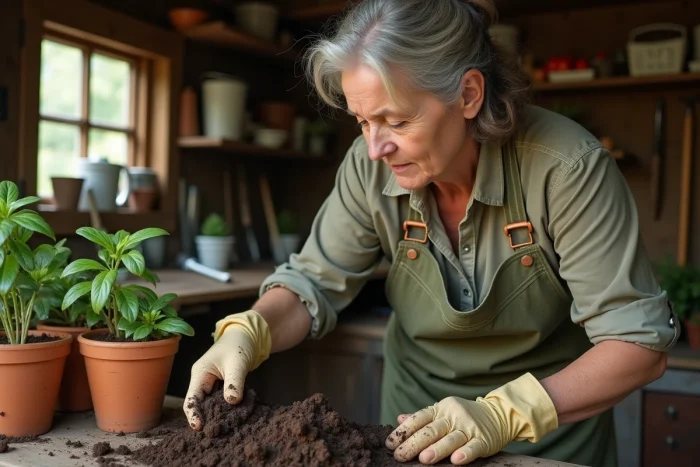
Stored soil for several months does not always show visible signs of degradation. However, the decomposition of organic matter alters its physicochemical properties long before any odor or mold appears. Assessing whether your soil is still usable requires going beyond a simple visual inspection and checking parameters that manufacturers themselves measure in the laboratory: pH, conductivity, water retention capacity.
pH and conductivity: the indicators that the bag no longer mentions
Fresh soil generally has a pH between 5.5 and 6.5 depending on the formulations. After several months of storage, the decomposition of organic components (peat, coconut fibers, composted bark) acidifies or alkalizes the substrate depending on the nature of the mix. Without measurement, this drift goes unnoticed.
We recommend using a soil pH meter or, if unavailable, colorimetric strips. Dip the probe into a sample moistened with distilled water. A pH lower than 5 or higher than 7 indicates a substrate whose buffering capacity is depleted. Even with the addition of suitable fertilizer, soil with a drifted pH no longer allows for proper nutrient assimilation by the roots.
Electrical conductivity (EC) indicates the concentration of mineral salts. Soil stored in a sealed bag in a warm place concentrates its salts through partial evaporation. Conversely, an open bag exposed to moisture sees its nutrients leached away. In both cases, the substrate no longer meets the characteristics guaranteed at purchase. To know if the soil is still good, cross-referencing these two measurements provides a much more reliable diagnosis than a simple odor check.
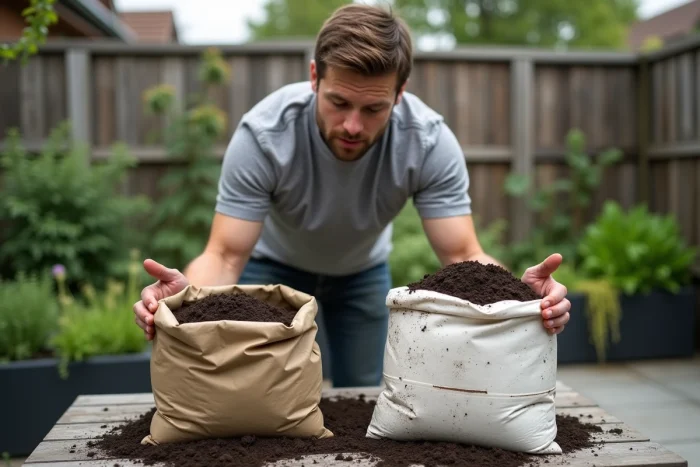
Hydrophobic soil after storage: the trap of coconut-based substrates
So-called “new generation” substrates, formulated with a significant amount of coconut fiber or blonde peat, have a specific aging defect. Once dehydrated, they become hydrophobic: water beads on the surface without penetrating the mass of the substrate.
This behavior can be tested in a few seconds. Pour a stream of water over a handful of dry soil placed in a saucer. If the water beads and slides off the sides instead of being absorbed, the substrate has lost its wettability. A classic peat-based soil reacts the same way, but coconut-based mixes dry out faster once the bag is opened, accelerating the phenomenon.
Rehydration is sometimes possible. Immerse the soil in a tub of lukewarm water for one to two hours, stirring regularly. If the substrate regains a homogeneous and spongy texture, it remains usable for less demanding plantings (mulching, filling decorative planters). However, a substrate that remains in compact clumps after soaking has lost its capillary structure and is no longer suitable for sowing or repotting.
Interveinal yellowing of plants: the signal that the soil masks
Many gardeners attribute leaf yellowing to a lack of fertilizer. When the leaves yellow between the veins while retaining green edges, the problem is often deeper. This symptom of interveinal chlorosis appears even when fertilizing continues, because the substrate no longer plays its role as a chemical buffer.
Exhausted soil no longer retains cations (calcium, magnesium, iron) on its exchange sites. Nutrients pass through the substrate without being captured by the roots. We frequently observe this pattern in houseplants repotted for more than two years without substrate renewal.
- Yellowing between the veins with remaining green veins: iron or magnesium deficiency related to a saturated or degraded substrate, not just a lack of fertilization.
- Soft leaves despite regular watering: compacted soil prevents root oxygenation and promotes root suffocation.
- Foul or rotten egg smell upon opening the bag: advanced anaerobic fermentation, a sign that the aerobic micro-life of the substrate is dead.
- Presence of sciarid larvae (small black flies): they develop in advanced decomposing organic matter.
These signals converge toward the same diagnosis: the soil has exceeded its functional usage duration, regardless of any date printed on the bag.
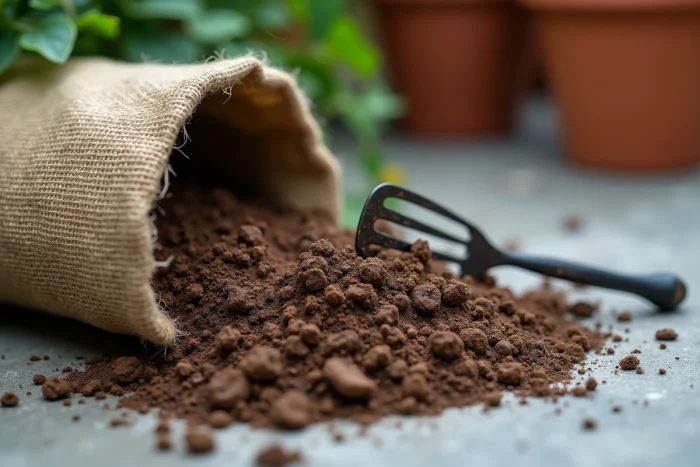
Expired soil for compost or amendment: arbitrate according to actual condition
Throwing away old soil at the dump remains a common reflex, but rarely justified. A substrate with a degraded structure still retains valuable organic matter. The question is not whether it is “good” or “bad,” but what use to redirect it to.
A compact soil, depleted of nutrients but without a smell of fermentation, can be incorporated into the compost pile as a carbon input. Mixed with nitrogen-rich green waste, it accelerates composting by adding volume and improving aeration of the pile.
Smelly soil or colonized by dense white mold requires a different treatment. Spread it in a thin layer in the sun for several days. Exposure to UV and drying eliminates a large part of the pathogens. This “sanitized” soil can then be used as a base amendment for ornamental beds, mixing it in equal parts with garden soil.
- Dry and crumbly soil without odor: reusable in a mix (one-third old soil to two-thirds fresh substrate) for less demanding plants.
- Compacted and hydrophobic soil: to be composted or used as temporary mulch.
- Fermented or infested soil: to be spread in the sun before any reuse, never in direct contact with seedlings or vegetable plants.
Prolonged storage also degrades the water retention capacity and the rate of active organic matter. Soil that is two years old, even if properly stored, no longer offers the performance of a new product for demanding crops like vegetable sowing or repotting tropical plants. For these uses, renewing the substrate remains the only reliable option.