
The string trimmer is the tool that makes the difference between a mowed garden and a truly well-maintained garden. Where the mower stops, against a wall, at the foot of a tree, or along a path, it takes over for a clean finish. Choosing the right model depends less on the budget than on the layout of the terrain, the type of vegetation to be cut, and the frequency of use.
Multi-tool battery platforms: a criterion that few buyers anticipate
Most guides compare string trimmers by type of power source (corded, battery, gas) without addressing a crucial point: battery compatibility with other garden tools. Major brands have developed ecosystems where a single battery powers the string trimmer, the mower, the blower, and sometimes the chainsaw.
For example, Einhell offers its Power X-Change 18 V platform, where the battery from the GE-CT 18/25-1 Li-Solo model fits the entire garden range. Makita, often sought after by demanding users, applies the same principle with its LXT batteries. Buying a string trimmer without checking the compatibility of its battery with your future tools amounts to paying two or three times the price of a charger and a battery.
To compare models based on this criterion and other technical parameters, specialized resources like taille-bordure-warrior.com allow filtering references by battery ecosystem, simplifying the search.
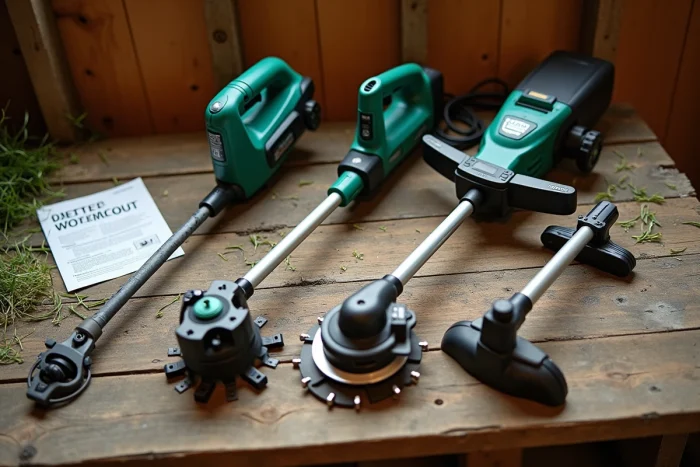
36 V string trimmer: an alternative to gas for medium and large gardens
The classic opposition between the 18 V model for small gardens and gas engines for large areas no longer reflects the market reality. 36 V battery string trimmers (or bi-18 V depending on the brands) now offer power and autonomy close to gas, without the maintenance, noise, or emissions constraints.
A 36 V model is suitable for the majority of medium to large gardens, provided you have a battery with sufficient capacity. Gas remains relevant for professionals working on very large areas or on overgrown land, where dense vegetation requires higher torque and nearly unlimited autonomy.
When gas retains a real advantage
On plots where the grass regularly exceeds knee height and where tough grasses grow against fences, the gas engine delivers constant torque without loss of power. Field reports diverge on this point for 36 V batteries: some users report a noticeable loss of power at the end of the charge on thick vegetation.
The quality of the lithium-ion cell and the electronic management of the brushless motor play a more decisive role than the announced voltage alone.
Pivoting head and edging mode: functions that change the finish
A string trimmer that cuts grass horizontally is the basic function. What distinguishes recent models is the ability of the cutting head to pivot to switch to vertical mode, often called “edger” mode.
- The pivoting head at 90 to 180 degrees allows for cleanly trimming the edge of the lawn along a path or flowerbed, without additional tools.
- Some models offer an integrated wheel guide to maintain a straight cutting line in vertical mode, preventing zigzag cuts.
- On entry-level devices, the head does not pivot or locks in a single intermediate position, which severely limits versatility.
Before buying, physically check (or on the technical sheet) the rotation range of the head. A pivot limited to 45 degrees is not sufficient for creating a clean edge.

Cutting line: diameter and profile, two often overlooked parameters
The line is the main wear part of the string trimmer, and its choice affects cutting quality as much as the motorization. Two characteristics deserve special attention.
The diameter of the line
A thin line is suitable for short grass and light finishing. For taller grasses or semi-woody weeds, a larger diameter withstands breakage better and cuts more effectively. The compatible diameter depends on the model: using a line that is too thick on an undersized motor accelerates wear on the drive mechanism.
The profile of the section
Round lines are the most common and versatile. Square, star, or twisted profiles improve cutting efficiency on dense vegetation by creating a more pronounced shearing effect. However, they generate more vibrations and noise. For regular domestic use on maintained lawns, a reinforced nylon round line represents the best compromise between durability and comfort.
Ergonomics and weight: what matters after the first half-hour
In stores, most string trimmers seem lightweight. The difference is felt after twenty to thirty minutes of continuous use, with arms extended and the cutting head close to the ground.
- The presence of a harness or shoulder strap distributes the weight across the shoulder and reduces wrist fatigue, especially on 36 V or gas models.
- An adjustable auxiliary handle in height and angle allows adapting the working position to one’s morphology.
- The total weight includes the battery: a device advertised as lightweight “without battery” can become cumbersome once equipped.
The overall balance of the tool, that is, the weight distribution between the motor and the cutting head, influences maneuverability much more than the gross weight. A slightly heavier but well-balanced model tires less than a lightweight device whose center of gravity pulls forward.
The choice of a string trimmer hinges on details that the product sheet does not always show: battery compatibility with your other tools, actual rotation range of the pivoting head, line diameter suited to your vegetation, balance in hand. Testing the tool in real conditions, even briefly, remains the best way to validate that it suits your garden and your working style.