
In France, 21% of employees believe they lose more than two hours a day on unproductive tasks. However, some companies show a growth of 15% simply by reorganizing the distribution of tasks. Productivity gaps between similar teams sometimes exceed 40%, with no direct link to the actual workload.
Efficiency does not depend on the length of the workdays or the number of digital tools available. A few targeted adjustments are often enough to transform daily organization and reduce stress. Adopting proven methods allows for a balance between performance and well-being, while limiting overload.
Why time management remains a major challenge in companies today
Time management in companies creates a constant tension between goals and daily reality. Employees, faced with an avalanche of meetings and incessant digital interruptions, race against deadlines while tasks pile up, sometimes without coherence. This cocktail fosters procrastination, increases stress, and degrades quality of life at work.
Companies seek to optimize working time to improve their productivity. But this exercise encounters a nuanced reality: without clear priorities, tasks become blurred and the collective direction becomes vague. The boundary between professional life and personal life fades, a phenomenon exacerbated by the rise of remote work. As a result, it becomes difficult to maintain the sought-after balance.
However, certain levers prove effective. For example, planning according to the principle of even and odd weeks allows for anticipating busy periods and adapting organization. This approach, explored in “Understanding Even and Odd Weeks to Optimize Your Schedule – The Business News,” involves segmenting tasks according to their nature or urgency.
Here are several concrete areas to move in this direction:
- Knowing how to prioritize priorities to limit dispersion.
- Reducing unnecessary solicitations to preserve moments of deep concentration.
- Establishing a work organization that respects everyone’s rhythm, which decreases procrastination and promotes collective success.
Time management is not limited to aligning tasks on a to-do list. It questions the relationship to trust, recognition, and efficiency within each team. Addressing structural blockages opens the door to new ways to optimize working time and build a peaceful professional environment.
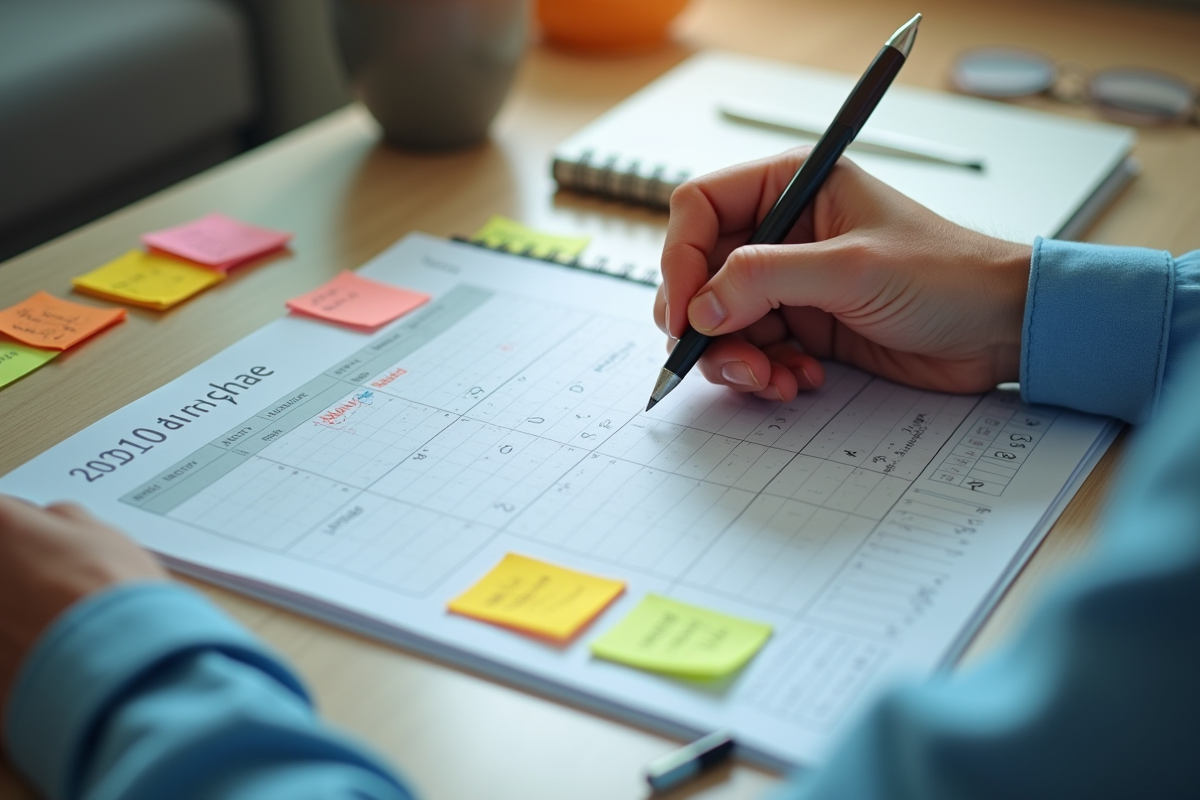
Concrete and easy-to-adopt methods to gain efficiency in daily life
Finding methods truly suited to optimizing working time is essential in every organization today. Relying on practical and recognized tools helps structure the day while lightening the mental load. Among the key solutions, the Pomodoro technique, invented by Francesco Cirillo, has gained many followers: 25 minutes of intense focus on a task, followed by a 5-minute break. This rhythm imposes discipline, curbs procrastination, and encourages welcome mental recovery.
To sort through the agenda, the Eisenhower matrix offers a simple framework: distinguishing the urgent from the important, and organizing priorities according to their real impact. Meanwhile, the Getting Things Done method designed by David Allen proposes to clear distracting thoughts from the mind by systematically categorizing projects and actions to be addressed.
The time blocking technique involves reserving each time slot for a specific task. This planning provides a clear view of the day and helps better allocate efforts. Some time management software facilitates this breakdown and highlights the most time-consuming tasks.
Here are a few simple tips to enhance collective efficiency:
- Alternating complex tasks with quicker missions to maintain motivation.
- Using collaborative tools to streamline the management of shared projects.
- Regularly evaluating the results achieved and adjusting one’s time management strategy accordingly.
Technology now enters as a partner, providing immediate solutions to face unexpected events and support both individual and collective efficiency. Mastering the art of organization also means allowing oneself to breathe, delegate, and move forward without exhausting oneself. Behind each method lies the promise of a calmer daily life, where time is no longer endured but chosen.